

Fire Triangle vs Fire Tetrahedron
Fire safety is one of the most important aspects of protecting lives, property, and the environment. Understanding how fire starts and spreads is the foundation of fire prevention and firefighting. Two important concepts used in fire safety are the Fire Triangle and the Fire Tetrahedron. While both explain the basic requirements for a fire to exist, the Fire Tetrahedron provides a more detailed understanding of the combustion process.
This article explains the difference between the Fire Triangle and Fire Tetrahedron, their components, importance, and practical applications in fire safety.
What is the Fire Triangle?
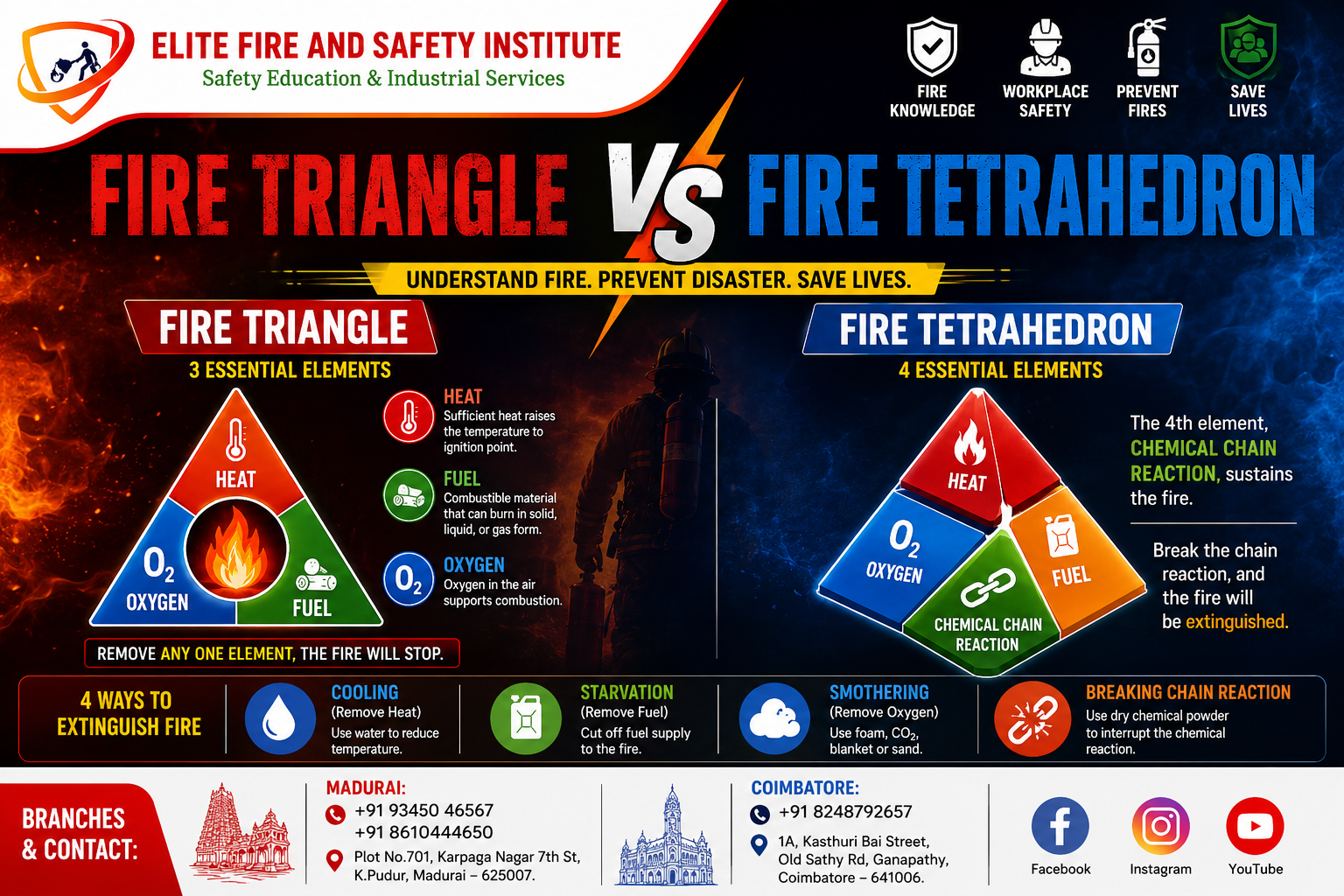
The Fire Triangle is the simplest model used to explain how a fire starts. It states that three essential elements are required for combustion:
- Heat
- Fuel
- Oxygen
If any one of these three elements is removed, the fire cannot start or will be extinguished.
1. Heat
Heat is the energy needed to raise the temperature of a material to its ignition point. Common sources of heat include:
- Electrical faults
- Open flames
- Hot surfaces
- Friction
- Welding and cutting operations
- Lightning
Without sufficient heat, fuel will not ignite.
2. Fuel
Fuel is any material that can burn. It may exist in solid, liquid, or gaseous form. Examples include:
- Wood
- Paper
- Cloth
- Petrol and diesel
- LPG and natural gas
- Plastics
- Chemicals
Different fuels have different ignition temperatures and burning characteristics.
3. Oxygen
Oxygen supports combustion. The atmosphere contains approximately 21% oxygen, which is sufficient for most fires to burn.
Some industrial environments also contain oxidizing agents that can intensify fires.
How the Fire Triangle Works
Imagine a campfire. Wood acts as the fuel, a match provides the heat, and oxygen from the surrounding air supports combustion. Remove any one of these elements, and the fire will stop.
For example:
- Pouring water removes heat.
- Closing a gas valve removes fuel.
- Using a foam blanket limits oxygen.
This simple concept forms the basis of many firefighting techniques.
What is the Fire Tetrahedron?
The Fire Tetrahedron expands the Fire Triangle by adding a fourth element:
- Heat
- Fuel
- Oxygen
- Chemical Chain Reaction
This model better explains how modern fires continue burning after ignition.
The Fourth Element: Chemical Chain Reaction
When fuel burns, it produces highly reactive molecules known as free radicals. These free radicals sustain a continuous chain reaction, generating more heat and maintaining combustion.
As long as this chemical reaction continues, the fire will keep burning.
Breaking this chain reaction extinguishes the fire, even if heat, fuel, and oxygen are still present.
This is why certain fire extinguishing agents are specifically designed to interrupt the chemical reaction.
Importance of the Fire Triangle
The Fire Triangle helps people understand:
- How fires start
- Basic fire prevention methods
- Safe handling of flammable materials
- Emergency response procedures It is widely taught in:
- Schools
- Fire and safety institutes
- Industrial safety programs
- Workplace induction training
Importance of the Fire Tetrahedron
The Fire Tetrahedron provides a more scientific explanation of fire. It helps professionals understand:
- Fire chemistry
- Fire suppression mechanisms
- Selection of fire extinguishers
- Industrial fire hazards
- Chemical fire behavior It is especially important in:
- Oil and gas industries
- Chemical plants
- Manufacturing industries
- Fire engineering
- Emergency response teams
Methods of Fire Extinguishment
Since fire requires all four elements, removing any one element will extinguish the fire.
1. Cooling (Removing Heat)
Water is commonly used to reduce the temperature of burning materials below their ignition point.
2. Starvation (Removing Fuel)
The fuel supply is removed by:
- Closing fuel valves
- Isolating combustible materials
- Removing nearby flammable substances This method is common in gas and fuel fires.
3. Smothering (Removing Oxygen)
Oxygen is cut off using:
- Foam
- CO₂ extinguishers
- Fire blankets
- Sand
Without oxygen, combustion stops.
4. Breaking the Chemical Chain Reaction
Dry Chemical Powder (DCP) extinguishers interrupt the chain reaction occurring in the flame.
They are highly effective for:
- Gas fires
- Liquid fires
- Electrical fires
Real-Life Examples
Electrical Fire
An overloaded electrical circuit ignites. Correct action:
- Switch off the electrical supply.
- Use a CO₂ extinguisher.
Water should never be used on energized electrical equipment.
Applications in Fire Safety
Understanding the Fire Triangle and Fire Tetrahedron helps in:
- Risk assessment
- Fire prevention planning
- Emergency preparedness
- Fire extinguisher selection
- Industrial safety management
- Workplace inspections
- Fire safety audits
Safety officers use these concepts daily to identify hazards and implement effective fire protection measures.
Why Every Safety Professional Should Learn These Concepts
Every safety professional should understand these models because they form the basis of:
- IOSH
- Diploma in Fire and Industrial Safety
- OSHA programs
- Industrial safety training
- Firefighting courses
A strong understanding of combustion principles enables professionals to prevent incidents, respond effectively during emergencies, and ensure workplace compliance with safety regulations.
Learn Fire Safety with Elite Fire and Safety Institute
Elite Fire and Safety Institute is committed to providing industry-focused safety education and practical training for students and working professionals. The institute offers a range of courses designed to build knowledge and skills in fire prevention, industrial safety, occupational health, and emergency response.
Students receive training in essential topics such as the Fire Triangle, Fire Tetrahedron, fire extinguishers, firefighting techniques, hazard identification, risk assessment, emergency evacuation procedures, and workplace safety standards. Experienced trainers and practical learning sessions help prepare students for careers in industries including construction, manufacturing, oil and gas, logistics, and healthcare.
Whether you are starting your career or looking to enhance your professional qualifications, Elite Fire and Safety Institute provides quality training to help you achieve your goals in the fire and safety field.
Conclusion
The Fire Triangle and Fire Tetrahedron are fundamental concepts in fire science. The Fire Triangle explains that heat, fuel, and oxygen are necessary for a fire to start, while the Fire Tetrahedron adds the chemical chain reaction to explain how combustion is sustained. By understanding these principles, individuals and organizations can implement effective fire prevention measures, choose the right firefighting methods, and improve overall workplace safety. Mastering these concepts is an essential step for anyone pursuing a career in fire and industrial safety.