


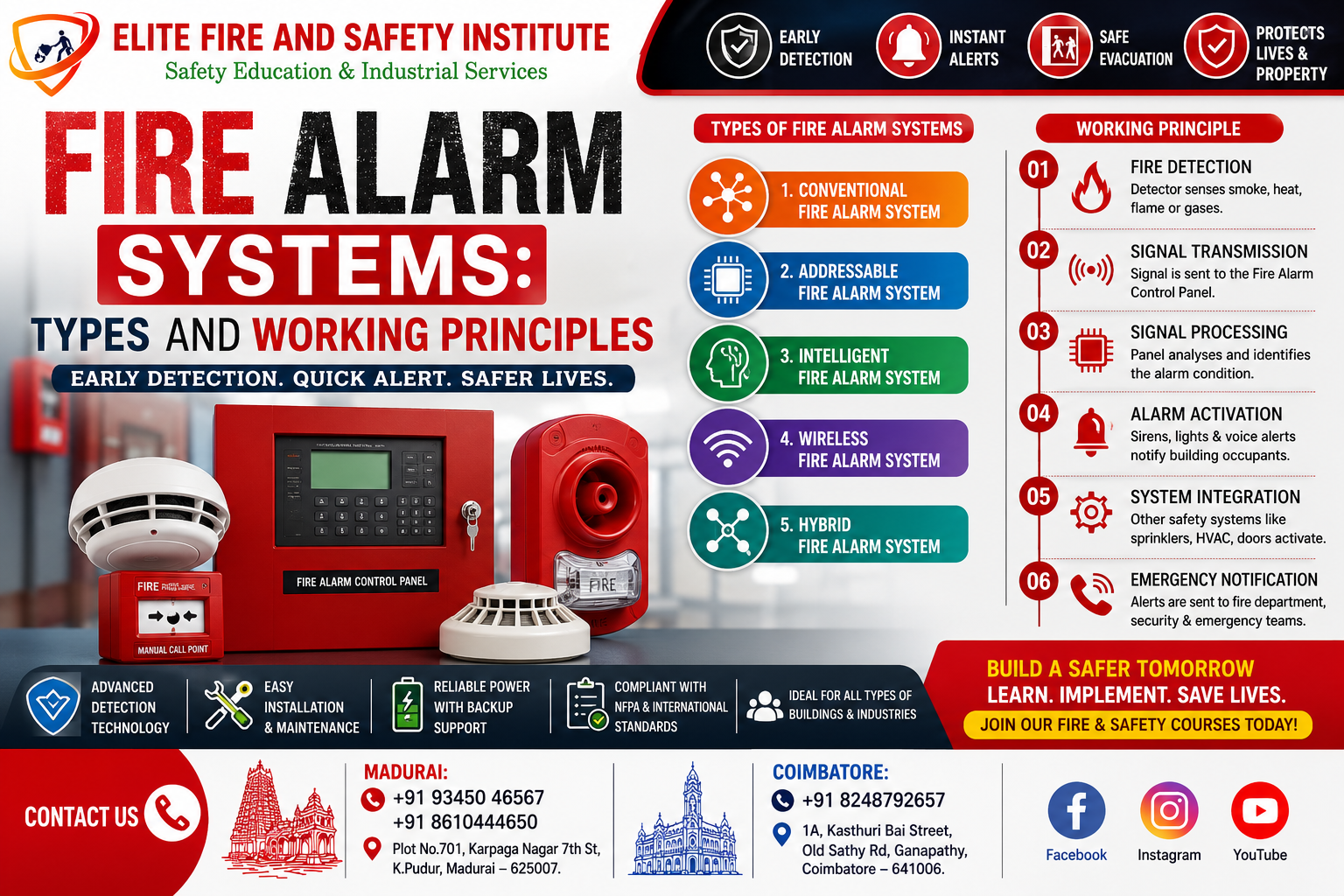
Fire Alarm Systems:
Types and Working Principles
Fire alarm systems are one of the most important life safety systems used in residential, commercial, industrial, and institutional buildings. Their primary purpose is to detect fire at its earliest stage, alert occupants, and initiate emergency response procedures to minimize loss of life and property. A properly designed and maintained fire alarm system plays a vital role in ensuring a safe environment for everyone.
As industries continue to prioritize workplace safety and comply with international safety standards, the demand for professionals with expertise in fire alarm systems is increasing. Learning the principles, components, and operation of fire alarm systems has become an essential part of fire and industrial safety education.
What is a Fire Alarm System?
A fire alarm system is an integrated network of devices that detects smoke, heat, or fire and provides an audible and visual warning to building occupants. Modern fire alarm systems can also communicate directly with fire departments, activate sprinkler systems, control ventilation, unlock emergency exits, and manage evacuation procedures.
Main Components of a Fire Alarm System
A fire alarm system consists of several interconnected components that work together.
1. Fire Alarm Control Panel (FACP)
The Fire Alarm Control Panel is the brain of the system. It receives signals from detectors and manual call points, processes the information, and activates alarms and other safety systems.
Functions include:
- Monitoring devices
- Processing alarm signals
- Identifying fault conditions
- Controlling notification appliances
- Recording alarm history
2. Smoke Detectors
Smoke detectors identify smoke particles before flames become large.
Common types include:
- Photoelectric Smoke Detectors
- Ionization Smoke Detectors
- Beam Smoke Detectors
- Aspirating Smoke Detection Systems
3. Heat Detectors
Heat detectors respond to rising temperatures rather than smoke.
Types include:
- Fixed Temperature Heat Detector
- Rate-of-Rise Heat Detector
- Combination Heat Detector
These are commonly installed in kitchens, warehouses, and dusty environments where smoke detectors may cause false alarms.
4. Manual Call Points (Break Glass Units)
Manual call points allow people to activate the fire alarm manually after spotting a fire.
These are usually installed:
- Near exits
- Staircases
- Escape routes
5. Alarm Notification Devices
These devices warn occupants.
Examples include:
- Sirens
- Horns
- Bells
- Flashing Strobe Lights
- Voice Evacuation Systems
6. Power Supply
Every fire alarm system requires:
- Primary electrical power
- Backup battery system
The battery ensures continuous operation during power failures.
Types of Fire Alarm Systems
Different buildings require different fire alarm systems depending on their size, occupancy, and fire risk.
1. Conventional Fire Alarm System
A conventional fire alarm system divides the building into zones.
When a detector activates, the control panel indicates the affected zone rather than the exact device.
2. Addressable Fire Alarm System
Each detector has a unique address or identification number.
The control panel identifies the exact location of the activated device.
3. Intelligent Fire Alarm System
An intelligent system continuously monitors detector conditions and analyses data before triggering alarms.
Features include:
- Automatic sensitivity adjustment
- Remote monitoring
- Advanced diagnostics
- Event history
- Network integration
These systems are commonly used in modern smart buildings.
4. Wireless Fire Alarm System
Wireless systems use radio communication instead of cables.
Benefits include:
- Faster installation
- Less disruption
- Flexible expansion
- Lower installation cost for existing buildings
Applications include:
- Heritage buildings
- Museums
- Temporary structures
- Renovation projects
5. Hybrid Fire Alarm System
Hybrid systems combine wired and wireless devices.
They provide flexibility while maintaining reliability.
Working Principle of a Fire Alarm System
The operation of a fire alarm system follows a systematic process.
Step 1: Fire Detection
A detector senses:
- Smoke
- Heat
- Flame
- Combustion gases
Step 2: Signal Transmission
The detector sends an electrical signal to the Fire Alarm Control Panel.
Step 3: Signal Processing
The control panel verifies the alarm condition.
It identifies:
- Device location
- Zone
- Alarm type
- System status
Step 4: Alarm Activation
Once confirmed, the panel activates:
- Sirens
- Flashing lights
- Voice evacuation messages
Occupants are instructed to evacuate immediately.
Step 5: Automatic System Integration
Modern fire alarm systems may automatically activate:
- Fire sprinklers
- Smoke extraction systems
- HVAC shutdown
- Fire doors
- Elevator recall
- Emergency lighting
Step 6: Emergency Notification
Many buildings automatically notify:
- Fire departments
- Security control rooms
- Facility managers
- Emergency response teams
Importance of Fire Alarm Systems
Fire alarm systems provide numerous safety benefits.
They help:
- Save lives
- Detect fires early
- Reduce property damage
- Improve evacuation speed
- Protect business operations
- Ensure legal compliance
- Reduce insurance losses
Without an effective fire alarm system, a small fire can quickly become a major disaster.
Maintenance of Fire Alarm Systems
Regular maintenance is essential for reliable performance.
Recommended activities include:
- Weekly alarm testing
- Monthly battery inspection
- Detector cleaning
- Cable inspection
- Functional testing
- Annual third-party inspection
- Documentation of maintenance records
Proper maintenance ensures compliance with national fire safety regulations and international standards such as NFPA and BS 5839.
Career Opportunities in Fire Alarm Systems
Professionals trained in fire alarm technology have excellent employment opportunities in various industries.
Popular job roles include:
- Fire Alarm Technician
- Fire Safety Officer
- Fire Protection Engineer
- Commissioning Engineer
- Maintenance Engineer
- Safety Supervisor
- HSE Officer
- Fire Protection System Designer
- Project Engineer
- Building Safety Consultant
Industries hiring fire alarm professionals include construction, oil and gas, manufacturing, healthcare, airports, educational institutions, hotels, and commercial complexes.
Role of Elite Fire and Safety Institute
Elite Fire and Safety Institute is one of the leading fire and industrial safety training institutes in Tamil Nadu, dedicated to developing skilled safety professionals for national and international industries. The institute offers comprehensive training that combines theoretical knowledge with practical applications to prepare students for real-world fire safety challenges.
The institute provides in-depth education on:
- Fire alarm systems and detection technologies
- Fire prevention and protection methods
- Fire extinguisher selection and operation
- Fire risk assessment
- Emergency response planning
- Permit to Work (PTW)
- Industrial safety management
- Occupational health and safety standards
- Hazard identification and risk assessment
Students receive practical exposure to fire alarm control panels, smoke detectors, heat detectors, manual call points, notification appliances, and emergency evacuation procedures. Experienced trainers use industry-relevant case studies and hands-on demonstrations to build technical competence and confidence.
Elite Fire and Safety Institute also offers career guidance, certification support, and placement assistance, helping students secure opportunities in industries such as construction, oil and gas, manufacturing, power plants, healthcare, and facility management. By emphasizing practical skills, safety compliance, and professional development, the institute equips learners with the knowledge required to build successful careers in fire and industrial safety.
Conclusion
Fire alarm systems are a critical component of modern fire protection and life safety. They provide early fire detection, immediate warning, and coordinated emergency response, significantly reducing the risk of injuries, fatalities, and property damage. Understanding the different types of fire alarm systems, their components, and their working principles is essential for anyone pursuing a career in fire and industrial safety.
With quality education and practical training from Elite Fire and Safety Institute, students can gain the expertise needed to install, maintain, inspect, and manage fire alarm systems while building rewarding careers in the rapidly growing fire and safety industry.