

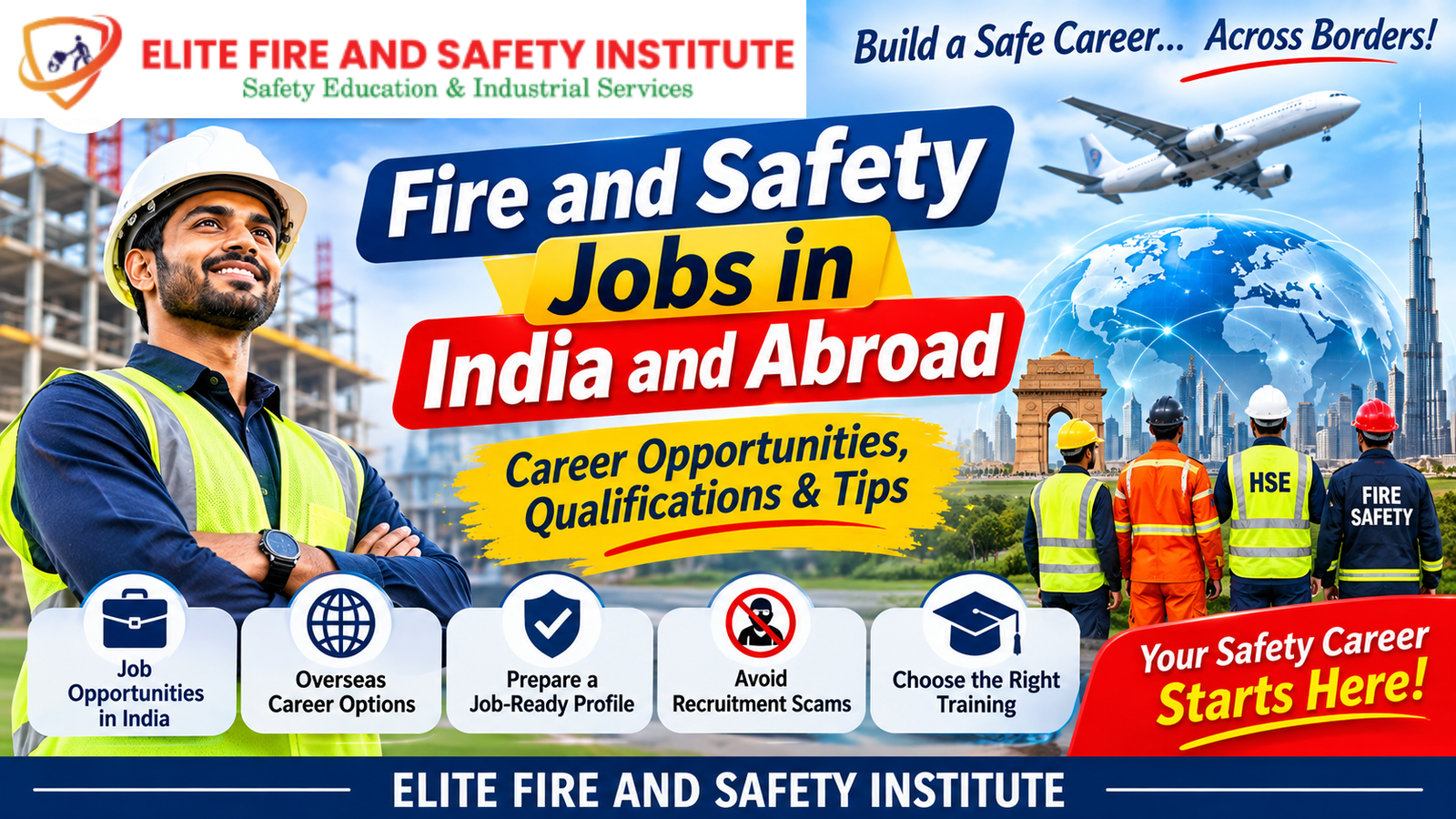
Fire and Safety Jobs in India and Abroad
Understanding opportunities, expectations, and responsible job searching
Introduction
Fire and safety professionals work in many sectors, including construction, manufacturing, energy, logistics, healthcare, facilities management, and large commercial operations. Job titles and entry requirements are not the same everywhere. A vacancy advertised in India may ask for different qualifications and experience from a similar role in the Gulf region or another country. Candidates should treat international employment as a planned career step, not as a guaranteed result of completing one course.
Opportunities Within India
In India, safety-related vacancies may be found with contractors, factories, infrastructure projects, warehouses, hospitals, hotels, and facility-management companies. Depending on the position, duties may include site inspections, fire equipment checks, worker inductions, PPE monitoring, hazard reporting, emergency drills, and documentation. Entry-level candidates may need to begin as trainees or assistants while gaining experience. Applicants should compare each employer’s eligibility criteria rather than assuming one qualification suits every job.
International Opportunities
Some employers in the Gulf and other international markets recruit safety personnel for construction, industrial maintenance, facilities, energy, and infrastructure projects. Requirements can include relevant education, documented work experience, recognised training, industry-specific knowledge, communication skills, and medical or visa eligibility. Requirements vary by country, employer, project, and job title. Candidates should check the official vacancy and applicable local rules before paying for a course or recruitment service.
What Employers Commonly Look For
Employers often want candidates who can recognise hazards, communicate clearly, keep accurate records, and follow site procedures consistently. Depending on the role, they may also expect knowledge of risk assessments, permit-to-work systems, working at height, confined spaces, lifting operations, fire protection, or incident investigation. Practical experience and the ability to describe real examples during an interview can be as important as a certificate.
Prepare a Job-Ready Profile
Create a clear CV that states your education, relevant courses, practical experience, language skills, and the type of role you want. List certificates accurately and avoid claiming approvals or competencies you do not hold. Prepare examples of how you identified a hazard, reported an unsafe condition, participated in a drill, or followed a safe procedure. Keep scanned copies of genuine certificates and experience letters ready for legitimate employers.
Avoid Recruitment Scams
Be cautious if someone promises a guaranteed overseas job, unusually high pay without an interview, or a visa in exchange for an urgent fee. Verify the employer, written offer, job location, salary, duty hours, accommodation, food, insurance, visa category, and deductions. Check whether the recruitment agent is authorised where required. Do not hand over original documents or make payments without clear, verifiable paperwork. If an offer seems suspicious, seek advice from official government resources or a trusted professional.
Choosing Training for Your Target Market
Before enrolling, identify the country, industry, and role you are targeting. Compare actual job advertisements to see which qualifications, experience, and technical skills appear repeatedly. Ask a training provider for written information about course duration, practical components, assessment, certificate issuer, and recognition. Do not assume that a certificate accepted by one employer or country will automatically be accepted by another.
How Elite Fire and Safety Institute Can Help
Elite Fire and Safety Institute can help prospective learners explore fire and safety training options and build a foundation for future applications. Learners should contact the institute to confirm current course availability, eligibility, certification details, fees, and any career-support services. Job seekers remain responsible for verifying each vacancy and ensuring their documents meet the employer’s requirements.
Conclusion
Career opportunities in India and abroad can be promising for candidates who prepare carefully. The strongest approach is to match training with a realistic job target, build experience, keep documents accurate, and verify every recruitment offer. A certificate can support a career plan, but it cannot replace competence, experience, or an employer’s specific eligibility requirements.
Branches & Contact:
Madurai:
+91 93450 46567 +91 8610444650
Plot No.701, Karpaga Nagar 7th St, K.Pudur, Madurai – 625007.
Coimbatore:
+91 8248792657
1A, Kasthuri Bai Street, Old Sathy Rd, Ganapathy, Coimbatore – 641006.