

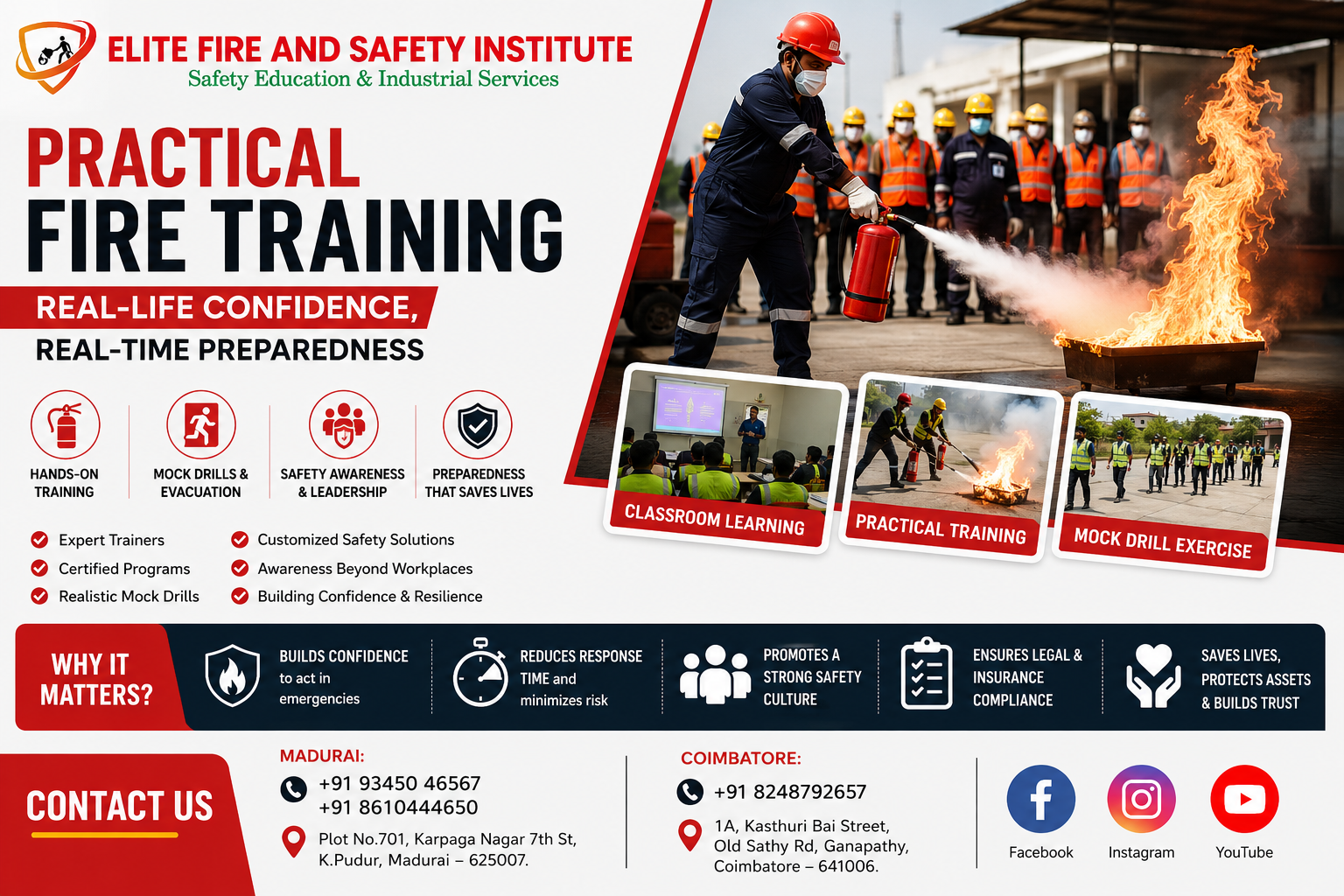
Real-Life Confidence Through Practical Fire Training
Hands-on familiarity with equipment Practical Fire Training:
People often hesitate in emergencies because they don’t know how to use tools. Practical training lets them physically operate extinguishers, hydrants, hoses, and alarms, removing uncertainty.
Understanding fire behavior:
Training explains how fires spread, the role of oxygen, and how different materials burn. This knowledge helps participants predict risks and act decisively.
Scenario-based learning:
Instead of abstract theory, trainees face simulated fires in kitchens, offices, or industrial settings. This builds confidence in handling diverse environments.
Stress inoculation:
Exposure to controlled fire situations reduces shock and panic. When participants hear alarms or see smoke during training, they learn to stay calm and focused.
Building leadership qualities:
Practical sessions often assign roles—leader, communicator, rescuer. This develops leadership and responsibility, ensuring someone can guide others during real emergencies.
Safety culture reinforcement:
Training instills a mindset where safety becomes second nature. Employees begin to notice hazards daily (blocked exits, faulty wiring) and proactively address them.
Boosting morale and trust:
Workers feel reassured knowing their organization invests in their safety. This confidence translates into loyalty and stronger workplace morale.
Skill transfer to daily life:
Beyond workplaces, trainees apply their skills at home or in public spaces, protecting families and communities.
Importance of Mock Drills in Fire & Safety Training
Testing readiness under pressure:
Drills simulate urgency—alarms, smoke machines, timed evacuations—so participants experience the stress of real emergencies.
Evaluating evacuation routes:
Drills reveal if pathways are clear, signage is visible, and assembly points are accessible. Any obstacles can be corrected before a real incident.
Improving communication systems:
They test whether alarms are audible, announcements are clear, and emergency contacts respond quickly.
Training for special needs:
Mock drills highlight how to assist elderly, disabled, or injured individuals, ensuring inclusivity in safety planning.
Coordination with external agencies:
Many drills involve fire brigades, hospitals, or police. This builds synergy between organizations and emergency responders.
Measuring response time:
By recording how long it takes to evacuate, organizations can set benchmarks and aim for faster, safer responses.
Reinforcing accountability:
Employees learn that safety is everyone’s responsibility, not just the fire officer’s. Drills encourage active participation.
Legal and insurance compliance:
Regular drills demonstrate adherence to safety laws, reducing liability and strengthening insurance claims in case of accidents.
Psychological conditioning:
Repetition ensures that when alarms sound, people act instinctively rather than freezing in fear.
Continuous improvement:
Each drill provides feedback—what went well, what failed—creating a cycle of learning and refinement.
Role of ELite Fire and Safety Institute
Elite Fire and Safety Institute strengthens this entire process by:
- Offering structured, certified training programs.
- Conducting realistic mock drills tailored to industries, schools, and hospitals.
- Providing expert trainers who explain fire dynamics and safety protocols.
- Collaborating with organizations to design customized safety policies.
- Running awareness campaigns to spread fire safety knowledge beyond workplaces.
- Empowering individuals with confidence, leadership, and resilience.
Conclusion
Practical fire training transforms ordinary individuals into confident responders by giving them skills, knowledge, and psychological resilience. Mock drills reinforce this confidence by testing preparedness, identifying weaknesses, and conditioning people to act instinctively. Together, they ensure that safety is not just a policy but a lived practice. Institutes like Elite Fire and Safety Institute play a vital role in embedding this culture of safety across workplaces and communities, ultimately saving lives and building trust.
CONTACT US
Madurai:
+91 93450 46567 +91 8610444650
Plot No.701, Karpaga Nagar 7th St, K.Pudur, Madurai – 625007.
Coimbatore:
+91 8248792657
1A, Kasthuri Bai Street, Old Sathy Rd, Ganapathy, Coimbatore – 641006.