

Fire & Safety Interview Preparation Guide
Fire and safety professionals play a crucial role in protecting lives, property, and the environment. Whether you are applying for a safety officer role in construction, oil & gas, manufacturing, or industrial plants, interviewers expect you to demonstrate both technical knowledge and practical awareness. Below are ten of the most common interview questions, along with model answers that can help you prepare effectively.
1. What are the elements of the Fire Triangle?
Answer: The fire triangle consists of heat, fuel, and oxygen. Fire occurs when all three are present. Removing any one element—such as cutting off oxygen or cooling the heat source—will extinguish the fire. This concept is fundamental to firefighting strategies.
2. How do you classify different types of fires?
Answer: Fires are classified into categories:
- Class A: Solid combustibles like wood, paper, cloth.
- Class B: Flammable liquids such as petrol, diesel, paints.
- Class C: Flammable gases like LPG, methane.
- Class D: Combustible metals such as magnesium, sodium.
- Class K (or F): Cooking oils and fats.
Knowing the classification ensures the correct extinguisher is used.
3. What is the purpose of a fire extinguisher?
Answer: Fire extinguishers are designed to suppress small fires before they spread. They are not substitutes for fire brigades but are vital for immediate response. Each type—water, foam, CO₂, dry chemical powder—targets specific fire classes.
4. What technique is used to operate a fire extinguisher?
Answer: The PASS method:
- Pull the pin.
- Aim at the base of the fire.
- Squeeze the handle.
- Sweep side to side.
This ensures maximum effectiveness and safety.
5. How often should fire drills be conducted?
Answer: Fire drills should be conducted at least twice a year in most workplaces. High‑risk industries may require quarterly drills. Regular practice ensures employees know evacuation routes and reduces panic during real emergencies.
6. What are common causes of workplace fires?
Answer: Electrical faults, improper storage of flammable materials, poor housekeeping, smoking in restricted areas, and human negligence are leading causes. Preventive measures include regular inspections, training, and strict compliance with safety protocols.
7. How do you conduct a fire risk assessment?
Answer: Steps include:
- Identify fire hazards.
- Evaluate who may be at risk.
- Assess likelihood and severity.
- Implement control measures.
- Review and update regularly.
This systematic approach ensures risks are minimized.
8. What is the role of PPE in fire safety?
Answer: Personal Protective Equipment (PPE) such as fire‑resistant clothing, helmets, gloves, and breathing apparatus protect workers from burns, toxic fumes, and falling debris. PPE is the last line of defense when engineering and administrative controls are insufficient.
9. How do you handle non‑compliance with fire safety rules?
Answer: First, educate the individual about the risks. If violations persist, enforce disciplinary measures according to company policy. Safety culture depends on accountability, so consistent enforcement is essential.
10. What is the importance of a fire evacuation plan?
Answer: A well‑designed evacuation plan ensures safe, orderly movement of people during emergencies. It minimizes confusion, prevents stampedes, and saves lives. Plans should be clearly displayed, rehearsed, and updated regularly.
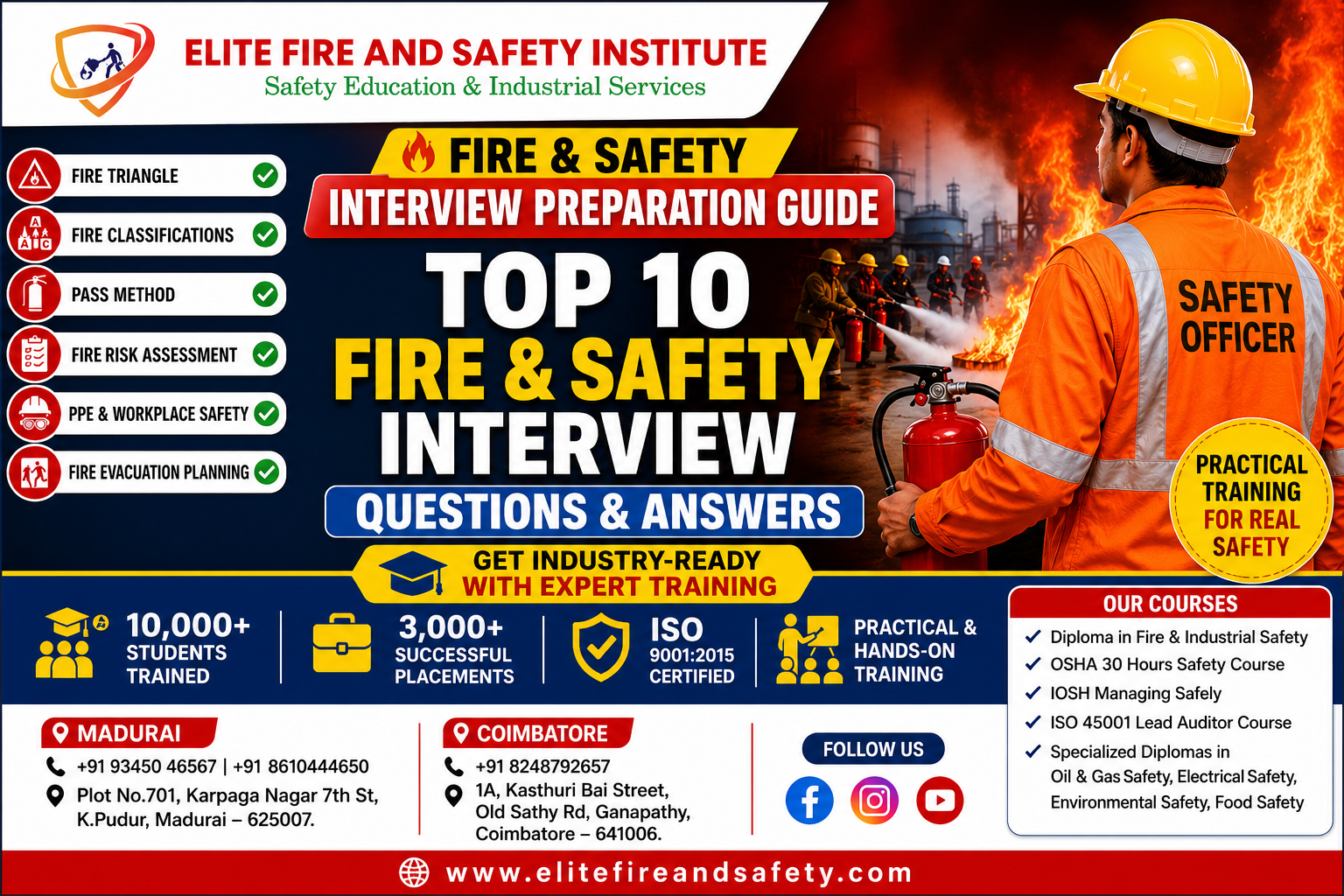
Elite Fire & Safety Institute – Tamil Nadu’s Leading Training Center
When preparing for interviews, formal training and certification can make a significant difference. One of the most respected institutions in Tamil Nadu is Elite Fire & Safety Institute, widely recognized for its practical approach and strong placement record.
📍 Reach and Reputation
- Headquartered in Tamil Nadu, with students from Madurai, Coimbatore.
- Over 10,000+ active students and 3,000+ successful placements in India and abroad.
- ISO 9001:2015 certified, with globally recognized credentials.
Courses Offered
Elite provides a wide range of programs tailored to industry needs:
- Diploma in Fire & Industrial Safety
- OSHA 30 Hours Safety Course
- IOSH Managing Safely
- ISO 45001 Lead Auditor Course
- Specialized diplomas in Oil & Gas Safety, Electrical Safety, Environmental Safety, and Food Safety
These courses are designed to meet international standards, making graduates employable both in India and overseas.
🛠 Training Approach
Unlike purely theoretical institutes, Elite emphasizes hands‑on training. Students participate in:
- Firefighting drills with real equipment.
- Confined space entry and rescue simulations.
- Work‑at‑height safety demonstrations.
- First aid and CPR workshops.
- Risk assessment exercises.
This practical exposure ensures students are confident in real‑world scenarios.
👨🏫 Faculty and Mentorship
Elite’s trainers are industry veterans with international certifications. They combine classroom teaching with field experience, giving students insights into actual workplace challenges. Mentorship extends beyond academics, guiding students in career planning and interview preparation.
💼 Career Support
One of Elite’s strongest features is its placement assistance. The institute has partnerships with companies in construction, oil & gas, manufacturing, and logistics. Services include:
- Resume building workshops.
- Mock interviews.
- Guidance for overseas opportunities.
- Continuous alumni support.
Final Thoughts
Preparing for a fire & safety interview requires both technical knowledge and practical confidence. Mastering the fire triangle, extinguisher use, risk assessments, and evacuation planning will help you stand out. At the same time, formal training from a reputed institute like Elite Fire & Safety Institute provides the credentials, skills, and confidence to succeed in demanding industries.
With its combination of internationally recognized courses, practical training, and strong placement record, Elite has become a trusted name for aspiring fire & safety professionals in Tamil Nadu. For anyone serious about building a career in this field, joining such an institute can be the difference between simply getting a job and truly excelling in the profession.
Branches & Contact:
Madurai:
+91 93450 46567 +91 8610444650
Plot No.701, Karpaga Nagar 7th St, K.Pudur, Madurai – 625007.
Coimbatore:
+91 8248792657
1A, Kasthuri Bai Street, Old Sathy Rd, Ganapathy, Coimbatore – 641006.