


Certifications That Can Support a Career in Health and Safety
How to assess certificate value, relevance, and recognition
Introduction
Health and safety certifications can help learners structure their knowledge and demonstrate training in particular subjects. Their value, however, depends on the course content, certificate issuer, assessment, target job, and employer requirements. There is no single certificate that automatically qualifies every person for every safety role. Candidates should check what a job actually asks for before choosing additional training.
Start With the Job Description
Collect several vacancies for the role and industry you want. Look for repeated requirements such as a relevant diploma, site experience, fire safety knowledge, first aid, risk assessment, auditing, or specialised worksite training. Separate mandatory requirements from desirable ones. This helps you prioritise courses that address a genuine skills gap instead of collecting certificates without a clear purpose.
Foundational Fire and Safety Training
A foundational course may introduce fire prevention, hazard identification, basic risk assessment, emergency evacuation, PPE, incident reporting, and safe work practices. Such learning can be useful for understanding workplace responsibilities, but the certificate’s acceptance depends on the employer and role. Confirm the syllabus, practical components, assessment method, and certificate issuer before enrolling.
Health and Safety Management Courses
Some programmes focus on occupational health and safety principles, workplace risk controls, management systems, or safety leadership. They may suit learners who want a broader understanding of how organisations plan and monitor safety. Check the course level, entry criteria, assessment requirements, and whether the qualification is relevant to the role you are targeting. Do not assume that a course title alone establishes professional recognition.
Auditor and Management-System Training
Auditor training may help participants understand how to assess a management system against a specified standard. Before selecting an ISO-related course, confirm the exact standard and version, the training provider, the examination or assessment, and the certificate issuer. Completing an auditor course does not by itself make someone an authorised certification body or guarantee employment as an auditor. Employers may require prior experience and additional competence.
Specialist and Short Courses
Short courses may address subjects such as first aid, CPR, fire warden duties, working at height, confined spaces, chemical safety, or emergency response. These courses have different purposes and may require refreshers or practical assessment. Choose them based on your work environment and the requirements of the employer. For higher-risk activities, training should be appropriate to the task and applicable local rules.
Verify Recognition Before Paying
Ask for the full name of the awarding organisation, the precise certificate title, assessment details, and a verification method. If a provider advertises approval or international recognition, request documentary evidence and verify it with the named organisation where possible. Be wary of claims that one certificate guarantees a job, salary, visa, or universal acceptance. Keep copies of course terms, payment receipts, and issued certificates.
Build Skills Alongside Certificates
Certificates are only one part of professional development. Employers may also expect site experience, clear report writing, communication, practical hazard recognition, and familiarity with relevant procedures. Practise explaining how you would identify a hazard, recommend a control, report a near miss, or support an evacuation. Keep learning as standards, equipment, and workplace risks change.
Course Enquiries at Elite Fire and Safety Institute
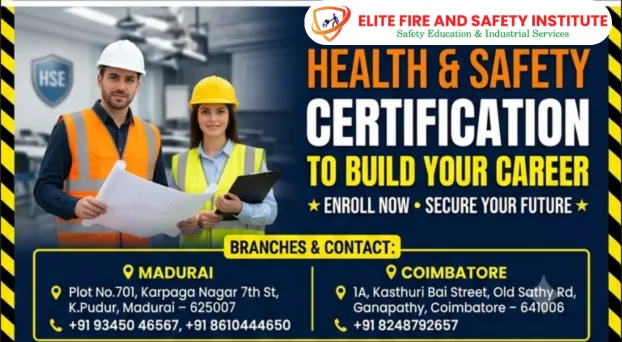
Prospective learners can contact Elite Fire and Safety Institute to ask about current fire and safety courses, short courses, eligibility, fees, assessment, and certificate details. Ask for written information about the awarding organisation and any claimed approval. Compare those details with real job requirements before committing to a programme.
Conclusion
A carefully selected certification can support a career when it fills a specific knowledge or qualification need. The sensible approach is to begin with the target job, verify the certificate, consider practical learning, and develop experience over time. Quality and relevance matter more than the number of certificates listed on a CV.
Branches & Contact:
Madurai:
+91 93450 46567 +91 8610444650
Plot No.701, Karpaga Nagar 7th St, K.Pudur, Madurai – 625007.
Coimbatore:
+91 8248792657
1A, Kasthuri Bai Street, Old Sathy Rd, Ganapathy, Coimbatore – 641006.