

Fire Triangle vs Fire Tetrahedron: Understanding How Fires Start and Spread
Introduction
Fire is a chemical reaction that releases heat and light, but it does not continue without the conditions that support it. Understanding these conditions helps workers choose the right prevention methods and respond more safely during an emergency. Two common models explain the science of fire: the fire triangle and the fire tetrahedron. Both are useful learning tools, but they describe different levels of detail.
The Fire Triangle Explained
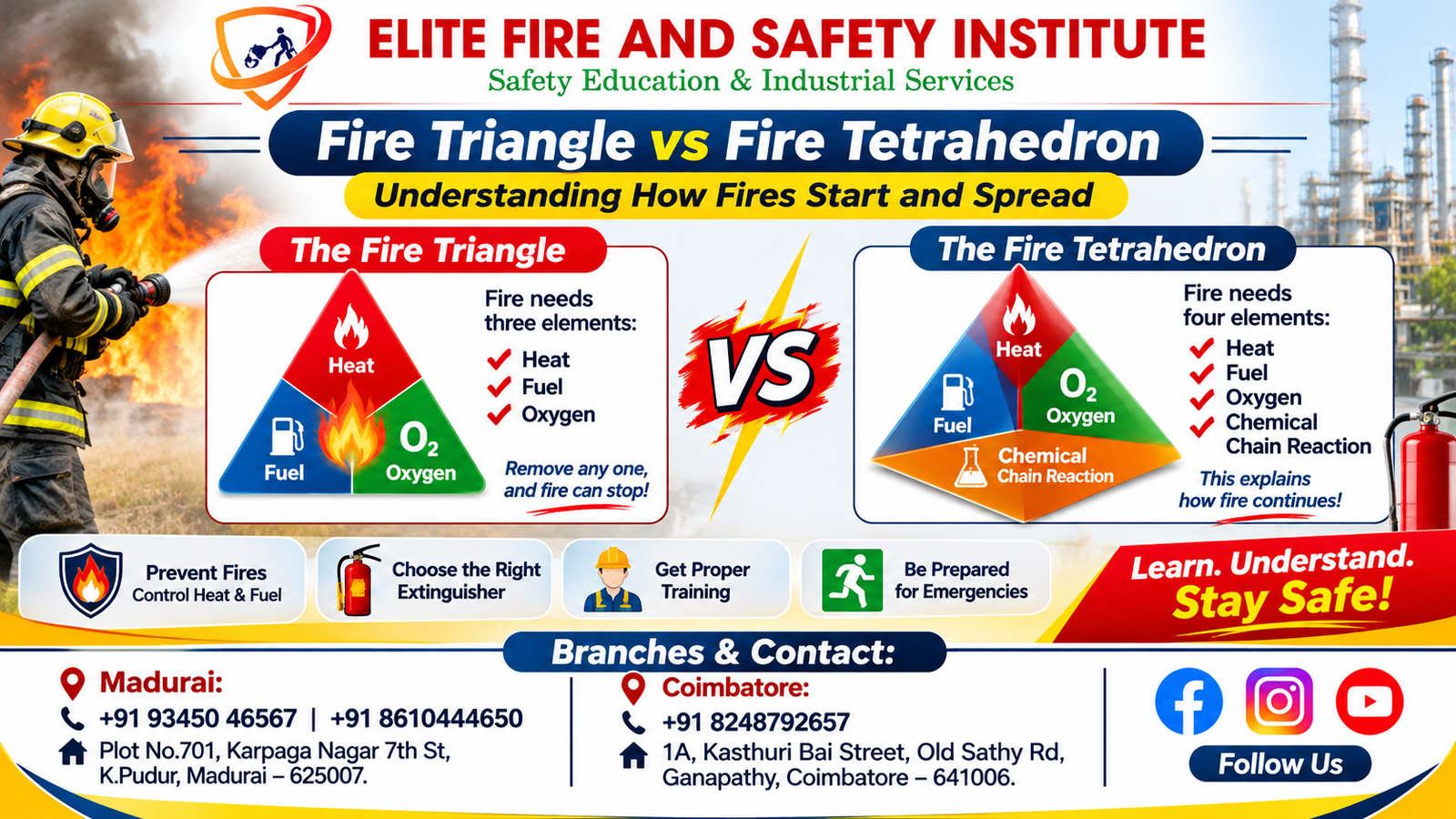
The fire triangle contains three elements: heat, fuel and oxygen. Heat raises a material to the temperature at which it can ignite. Fuel is the material that burns, such as paper, wood, petrol vapour or certain gases. Oxygen, usually supplied by the surrounding air, supports combustion. When all three are present in suitable conditions, a fire can start and continue. Removing or controlling any one of these elements can help prevent or extinguish some fires.
The Fire Tetrahedron Explained
The fire tetrahedron adds a fourth element: the chemical chain reaction. During combustion, chemical reactions produce heat and reactive particles that help the burning process continue. The tetrahedron therefore explains why some extinguishing agents work by interrupting the reaction, rather than only cooling the material or separating it from oxygen. It gives a more complete model of how combustion is sustained.
Key Differences
The triangle is a simple model with three sides—heat, fuel and oxygen—making it useful for introducing basic fire science. The tetrahedron has four elements and includes the chemical chain reaction. Both models show that fire needs specific conditions, but the tetrahedron gives a fuller explanation of combustion. Neither model replaces a proper risk assessment or the need to identify the type of fire before selecting firefighting equipment.
How the Models Help Prevent Fires
A workplace can reduce heat sources through equipment maintenance, control of hot work and safe electrical practices. Fuel risks can be reduced by storing flammable liquids correctly, keeping waste under control and separating incompatible materials. Oxygen is present in normal air, so prevention usually focuses on controlling ignition sources and fuel rather than trying to remove oxygen from an occupied space. Fire doors, compartmentation and good housekeeping can limit fire spread.
How Extinguishing Methods Relate to the Models
Water can cool suitable burning materials, reducing heat. Foam may help cover certain flammable-liquid surfaces and limit the release of vapours, depending on the product and fire. Carbon dioxide can help displace oxygen locally and is used for certain suitable fires, though it has important limitations and can be dangerous in confined spaces. Some dry chemical agents interrupt the combustion chain reaction. The correct extinguisher depends on the fuel, electrical hazards, environment and local guidance.
Why Choosing the Correct Extinguisher Matters
An extinguisher suitable for one fire can be ineffective or dangerous for another. Water must not be used on energised electrical equipment or burning cooking oil. Flammable-liquid fires require equipment designed for that hazard. If a fire is growing, smoke is spreading or the exit is threatened, people should raise the alarm, evacuate and contact emergency responders rather than attempt firefighting. Only trained people should tackle a small fire when a safe escape route remains available.
Learning Fire Science Through Training
Fire and safety students benefit from seeing the triangle and tetrahedron applied to realistic scenarios. Training can cover ignition sources, fuel storage, fire classes, extinguisher limitations, alarm procedures and evacuation. At Elite Fire and Safety Institute, learners can enquire about fire safety training options that help connect core concepts with practical prevention and emergency preparedness.
Conclusion
The fire triangle teaches the three basic conditions needed for fire, while the fire tetrahedron adds the chemical chain reaction. Together, they help explain prevention and the principles behind different extinguishing methods. Applying this knowledge safely means assessing the hazard, choosing appropriate controls and prioritising evacuation whenever a fire cannot be managed safely.
Branches & Contact:
Madurai:
+91 93450 46567 +91 8610444650
Plot No.701, Karpaga Nagar 7th St, K.Pudur, Madurai – 625007.
Coimbatore:
+91 8248792657
1A, Kasthuri Bai Street, Old Sathy Rd, Ganapathy, Coimbatore – 641006.