


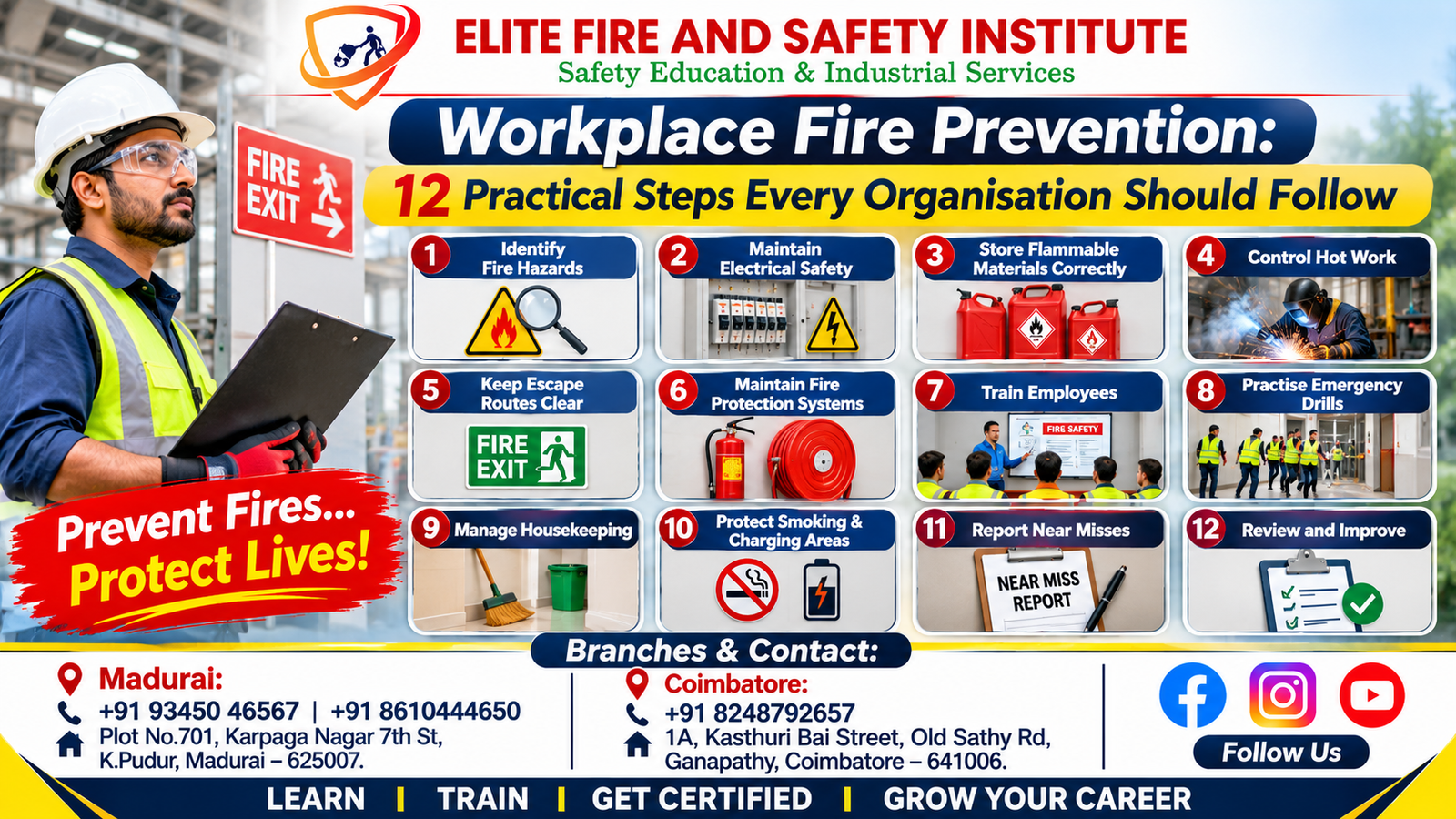
Workplace Fire Prevention: 12 Practical Steps Every Organisation Should Follow
Introduction
A workplace fire can threaten lives, damage equipment, disrupt business and affect neighbouring properties. Many fire incidents can be prevented or their impact reduced through organised maintenance, safe storage, employee awareness and effective emergency planning. Fire prevention is not a one-time activity; it is a daily responsibility shared by management, supervisors, contractors and workers.
1. Identify Fire Hazards
Start by inspecting the workplace for ignition sources, combustible materials, flammable liquids, gas leaks, overloaded sockets and blocked escape routes. Consider how activities change during maintenance, construction or seasonal production. Record the hazards, assess the risks and assign responsibility for corrective action.
2. Maintain Electrical Safety
Damaged cables, loose connections, unsuitable equipment and overloaded circuits can create heat or sparks. Use qualified personnel for electrical work, avoid temporary wiring as a permanent solution and remove defective equipment from service. Do not ignore repeated tripping, burning smells or unusual heat.
3. Store Flammable Materials Correctly
Keep flammable liquids in suitable, labelled containers and approved storage areas. Separate them from ignition sources and incompatible substances. Keep quantities in work areas to the minimum required and follow the product safety data sheet and applicable rules. Never store chemicals in unlabelled drink bottles.
4. Control Hot Work
Welding, cutting and grinding can produce sparks and hot particles. Use a permit-to-work system where required, clear or protect combustible materials, provide suitable firefighting equipment and arrange a fire watch when the risk assessment calls for it. Inspect the area after the work ends, following the site procedure.
5. Keep Escape Routes Clear
Corridors, stairways, exits and access to firefighting equipment must not be blocked by stock, furniture or waste. Exit doors should function as intended and emergency signs should remain visible. Workers need to know at least the appropriate escape routes from their work area.
6. Maintain Fire Protection Systems
Inspection and maintenance schedules should cover alarms, detectors, extinguishers, hydrants, hose reels, emergency lighting, fire doors and suppression systems as applicable. Keep records and arrange repairs promptly. Equipment should be suitable for the hazard and maintained by competent people.
7. Train Employees
Workers should know how to raise the alarm, leave the building, report hazards and reach the assembly point. Training should match the risks of the site and be repeated when conditions or staff change. Only trained and authorised people should use firefighting equipment.
8. Practise Emergency Drills
Drills help reveal confusion about routes, alarms, responsibilities and assembly arrangements. Review each drill, record issues and set deadlines for improvements. Include contractors and visitors in the arrangements where relevant.
9. Manage Housekeeping
Remove combustible waste regularly, control dust where it creates a fire or explosion hazard and keep storage organised. Good housekeeping makes hazards easier to spot and keeps access routes clear.
10. Protect Smoking and Charging Areas
Apply designated smoking rules and safely manage battery-charging areas. Follow manufacturer guidance for charging equipment, use appropriate chargers and remove damaged batteries from service under the approved procedure. Do not ignore swelling, overheating or unusual odours.
11. Report Near Misses
A small spark, overheating cable or minor smoke event can reveal a larger weakness. Encourage workers to report near misses without fear of unfair blame. Investigate causes and verify that corrective actions are completed.
12. Review and Improve
Review fire risk assessments after changes to layout, equipment, materials, processes or occupancy, and after incidents or drills. Assign named owners to actions and check whether controls remain effective.
Conclusion
Effective fire prevention combines hazard identification, maintenance, training and leadership. Organisations should follow applicable fire codes and local authority requirements, use competent specialists where needed and keep emergency plans current. At Elite Fire and Safety Institute, learners can enquire about fire safety training that supports workplace awareness and preparedness.
Branches & Contact:
Madurai:
+91 93450 46567 +91 8610444650
Plot No.701, Karpaga Nagar 7th St, K.Pudur, Madurai – 625007.
Coimbatore:
+91 8248792657
1A, Kasthuri Bai Street, Old Sathy Rd, Ganapathy, Coimbatore – 641006.