


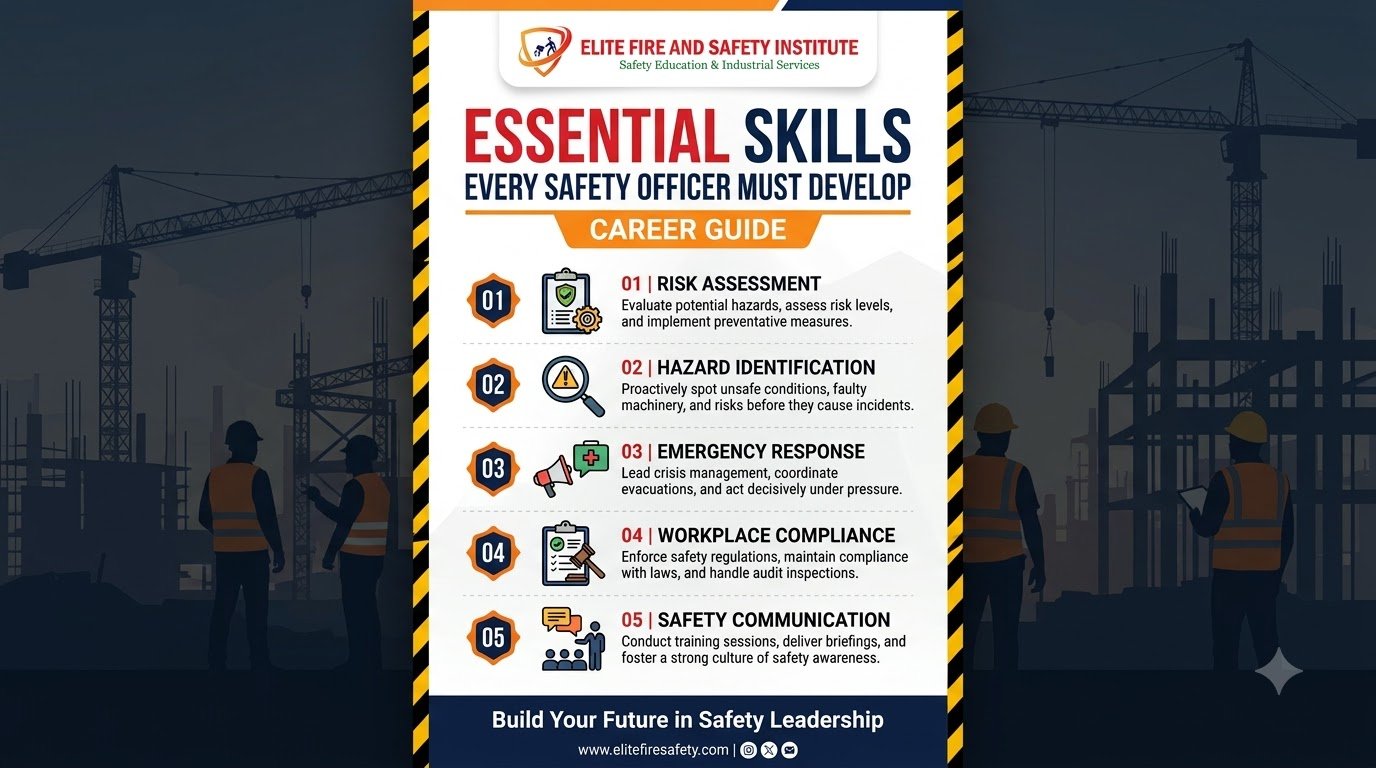
Essential Skills Every Safety Officer Must Develop
Technical knowledge and people skills for safer workplaces
Introduction
A safety officer needs more than the ability to identify a hazard. The role requires a combination of technical understanding, communication, documentation, judgement, and personal discipline. These skills help turn written procedures into practical controls that workers can follow. New entrants can build them gradually through structured training, supervised experience, feedback, and regular practice.
1. Hazard Identification
Hazard identification means noticing anything with the potential to cause harm. Examples include moving machinery, exposed electrical parts, unstable loads, chemical exposure, hot surfaces, blocked exits, and poor housekeeping. A useful habit is to observe the work process as well as the physical area. Ask what could go wrong, who might be affected, and whether conditions could change during the task.
2. Risk Assessment
After identifying hazards, a safety officer helps evaluate the likelihood and potential severity of harm and determine appropriate controls. The process should be proportionate to the task and follow the organisation’s method. Controls should not rely only on warning signs or personal protective equipment when stronger options—such as eliminating the hazard, substituting a dangerous material, or using engineering controls—are feasible.
3. Clear Communication
A safety instruction is effective only if people understand it. Officers need to explain hazards in direct language, listen to workers’ concerns, and adapt their communication to the audience. Toolbox talks should focus on the task at hand rather than simply reading a long list of rules. Respectful communication encourages reporting and makes it easier to resolve unsafe conditions before they lead to an incident.
4. Observation and Attention to Detail
Small changes can indicate a developing problem: a fire door held open, a damaged hose, a missing guard, or a new obstruction near an exit. Systematic observation helps officers notice these issues before an emergency. Checklists can support consistency, but they should not replace thinking. The officer must consider whether the actual conditions match the assumptions in the checklist.
5. Documentation and Reporting
Safety work depends on accurate records. Inspection reports, training attendance, incident details, permit documents, and corrective-action logs should be clear, factual, dated, and easy to trace. Avoid vague wording or unsupported conclusions. A strong report identifies the observation, risk, recommended action, responsible person, and follow-up status, in line with the site’s reporting process.
6. Emergency Readiness
Safety officers should understand the site alarm arrangements, evacuation routes, assembly points, emergency contacts, and the limits of their assigned response role. Practical drills help teams test whether procedures work in real conditions. Specialist response duties may require additional training; nobody should attempt a task beyond their competence or the site’s emergency instructions.
7. Teamwork and Problem-Solving
Safety is shared across workers, supervisors, maintenance teams, contractors, and management. Officers need to collaborate, ask useful questions, and help find workable controls. If a repeated problem occurs, they should look for contributing factors such as unclear instructions, equipment design, workload, access, or inadequate maintenance instead of assuming that reminders alone will solve it.
8. Professional Integrity
A safety officer must report facts honestly, protect confidential information, and avoid changing records to make performance appear better. If a control is missing or a task is unsafe, concerns should be raised through the proper channels. Knowing when to ask for specialist help is a sign of professionalism, not weakness.
Ways to Practise These Skills
Learners can practise by completing sample site inspections, writing a mock incident report, delivering a short toolbox talk, and carrying out a simple risk assessment under supervision. Reviewing real job descriptions can also reveal the skills employers expect. Elite Fire and Safety Institute can be contacted for current course information and details about practical learning activities; candidates should verify course content and certification claims before enrolling.
Conclusion
Strong safety officers combine technical knowledge with clear communication, reliable records, sound judgement, and ethical behaviour. These capabilities develop through repeated practice and a willingness to learn. The aim is not merely to find faults, but to help people understand risk and put effective controls into everyday work.
Branches & Contact:
Madurai:
+91 93450 46567 +91 8610444650
Plot No.701, Karpaga Nagar 7th St, K.Pudur, Madurai – 625007.
Coimbatore:
+91 8248792657
1A, Kasthuri Bai Street, Old Sathy Rd, Ganapathy, Coimbatore – 641006.