

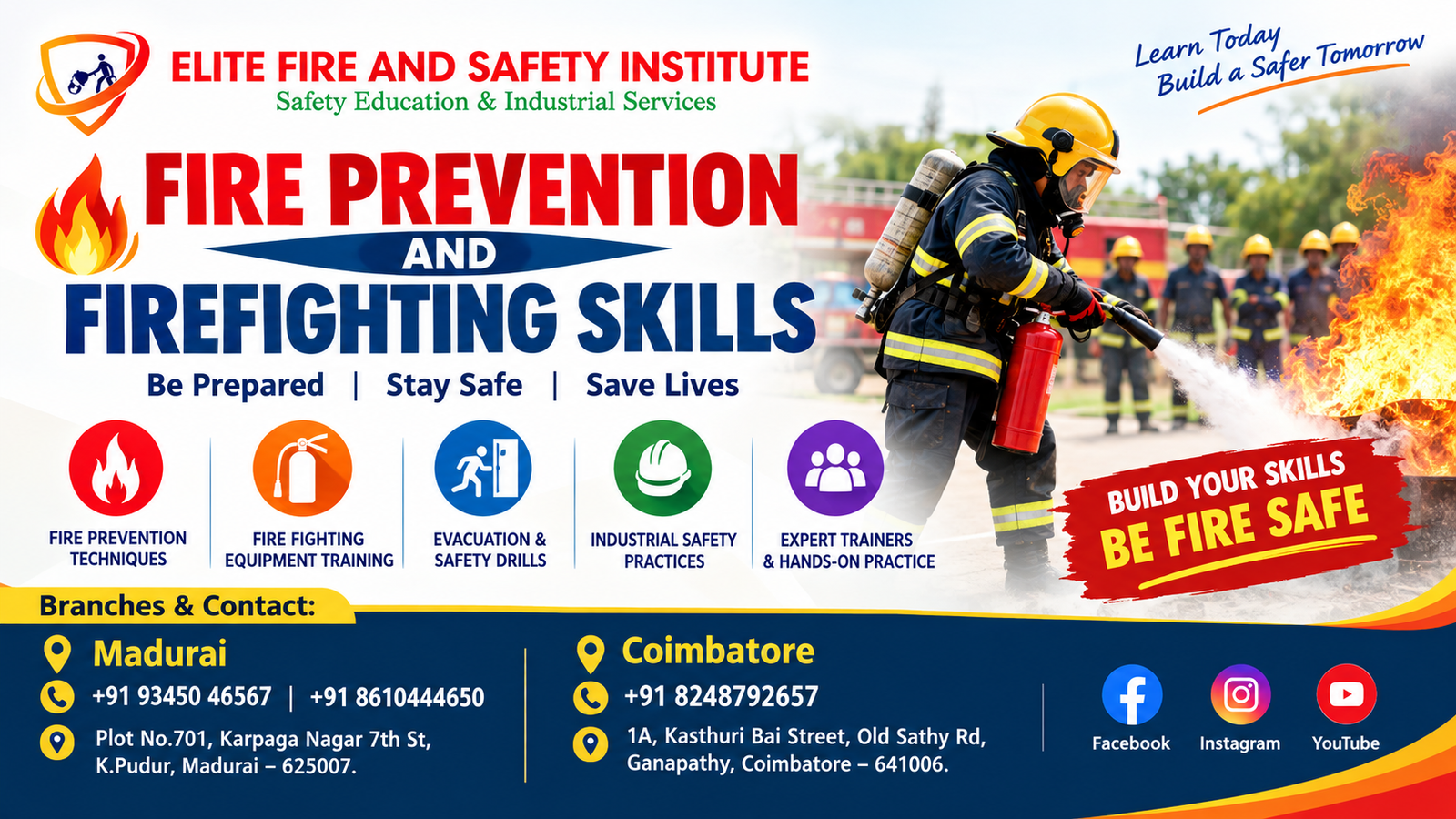
Fire Prevention and Firefighting Skills
The role of a Safety Officer has changed significantly. Modern workplaces are becoming more technologically advanced, and safety professionals are expected to manage not only traditional fire hazards but also complex industrial risks, digital safety systems and emergency situations.
In 2026, a successful Safety Officer needs a combination of technical knowledge, practical skills, communication abilities and digital awareness. Fire prevention and emergency response remain essential, but today’s safety professionals must also understand technology, risk assessment, workplace behaviour and continuous improvement.
For students and professionals planning a career in fire and safety, developing these skills can help build a strong foundation for opportunities across industries.
1. Fire Prevention and Firefighting Skills
A Safety Officer must understand the fundamentals of fire prevention and firefighting.
Important areas include:
- Fire triangle and fire tetrahedron
- Classification of fires
- Fire extinguishers and their applications
- Fire hydrant and sprinkler systems
- Fire alarm and detection systems
- Emergency response procedures
- Fire evacuation procedures
- Firefighting equipment inspection
Practical knowledge is especially important because a Safety Officer may need to respond quickly during an emergency.
2. Risk Assessment and Hazard Identification
Identifying hazards before an accident occurs is one of the most important responsibilities of a Safety Officer.
Safety professionals should be able to identify:
- Fire and explosion hazards
- Electrical hazards
- Chemical hazards
- Mechanical hazards
- Work-at-height risks
- Confined-space hazards
- Occupational health risks
- Unsafe acts and unsafe conditions
Tools such as Job Safety Analysis (JSA), Risk Assessment and Hazard Identification help organizations control workplace risks systematically.
3. Emergency Response and Crisis Management
Emergencies require quick decisions and effective coordination.
Safety Officers should know how to manage situations such as:
- Industrial fires
- Chemical spills
- Gas leaks
- Explosions
- Medical emergencies
- Evacuations
- Natural disasters
Regular emergency drills and training help employees understand their responsibilities and improve organizational preparedness.
4. Knowledge of Fire Safety Technology
Technology is becoming an important part of modern fire protection.
Safety Officers should have basic knowledge of systems such as:
- Addressable fire alarm systems
- Smoke and heat detectors
- Automatic sprinkler systems
- Fire suppression systems
- CCTV-based fire detection
- Gas detection systems
- Emergency communication systems
- Building Management Systems (BMS)
Understanding how these systems operate allows Safety Officers to identify problems and coordinate effectively with maintenance and technical teams.
5. Digital and Data Skills
Safety management is increasingly becoming data-driven.
Safety Officers may use digital tools for:
- Safety inspections
- Incident reporting
- Risk assessments
- Training records
- Audit documentation
- Corrective-action tracking
- Safety performance monitoring
Basic knowledge of spreadsheets, digital reporting systems and data analysis can therefore be valuable.
6. Communication and Leadership
Technical knowledge alone is not enough.
A Safety Officer must communicate clearly with workers, supervisors, managers, contractors and emergency-response teams.
Important communication skills include:
- Conducting toolbox talks
- Giving safety training
- Preparing safety reports
- Communicating emergency instructions
- Coordinating evacuation
- Conducting safety meetings
- Encouraging employees to report hazards
Leadership is equally important because safety depends on cooperation throughout an organization.
7. Safety Culture and Behaviour
Modern safety management focuses not only on rules but also on workplace behaviour.
A good Safety Officer should encourage employees to:
- Follow safe work procedures
- Report hazards
- Participate in safety training
- Use PPE correctly
- Follow emergency procedures
- Learn from incidents and near misses
Building a positive safety culture can help organizations move from simply reacting to accidents toward preventing them.
8. Knowledge of Safety Standards and Regulations
Safety Officers should understand the standards and legal requirements applicable to their industry.
Depending on the job role, professionals may encounter areas such as:
- Occupational safety requirements
- Fire safety regulations
- Environmental requirements
- Permit-to-work systems
- Emergency preparedness
- Personal protective equipment
- Industrial safety standards
Keeping knowledge updated is important because safety requirements and industry practices can change.
9. Investigation and Root Cause Analysis
When an incident occurs, the Safety Officer should look beyond the immediate cause.
Incident investigation may involve:
- 1. Collecting information
- 2. Interviewing witnesses
- 3. Examining the workplace
- 4. Identifying immediate causes
- 5. Identifying underlying causes
- 6. Conducting root cause analysis
- 7. Recommending corrective actions
- 8. Monitoring implementation
The objective is to learn from incidents and reduce the possibility of recurrence.
10. Continuous Learning
Fire and safety is a constantly developing field. New technologies, industrial processes and safety practices create a need for continuous professional development.
Safety professionals can strengthen their knowledge through:
- Fire & Safety courses
- First Aid and CPR training
- IOSH courses
- NEBOSH qualifications
- OSHA training
- ISO management-system training
- Emergency response training
- Practical firefighting training
Career Opportunities in 2026
Professionals with fire and safety knowledge can find opportunities in different sectors, depending on their qualifications, experience and applicable requirements.
Potential sectors include:
- Manufacturing
- Construction
- Oil and gas
- Power plants
- Hospitals
- Hotels
- Warehouses and logistics
- Infrastructure projects
- Chemical industries
- Corporate facilities
- Fire protection companies
Job titles may include Safety Officer, Fire & Safety Officer, HSE Officer, Safety Supervisor, Fire Protection Technician and EHS Executive, depending on the organization and qualification requirements.
Conclusion
The Safety Officer of 2026 needs more than basic firefighting knowledge. Modern safety professionals need a combination of fire prevention, risk assessment, emergency response, technology awareness, communication, leadership and continuous learning.
For students beginning their Fire & Safety career, developing these skills through structured education and practical training can provide a strong foundation for professional growth.
Build Your Fire & Safety Career with Elite
Elite Fire and Safety Institute focuses on developing practical knowledge and professional skills for students and working professionals interested in the Fire & Safety field.
If you are planning to build a career in fire and safety, choosing the right training program and developing practical skills can be an important first step toward your professional journey.
Elite Fire and Safety Institute – Building Skills for a Safer Future.
Branches & Contact:
Madurai:
+91 93450 46567 +91 8610444650
Plot No.701, Karpaga Nagar 7th St, K.Pudur, Madurai – 625007.
Coimbatore:
+91 8248792657
1A, Kasthuri Bai Street, Old Sathy Rd, Ganapathy, Coimbatore – 641006.