


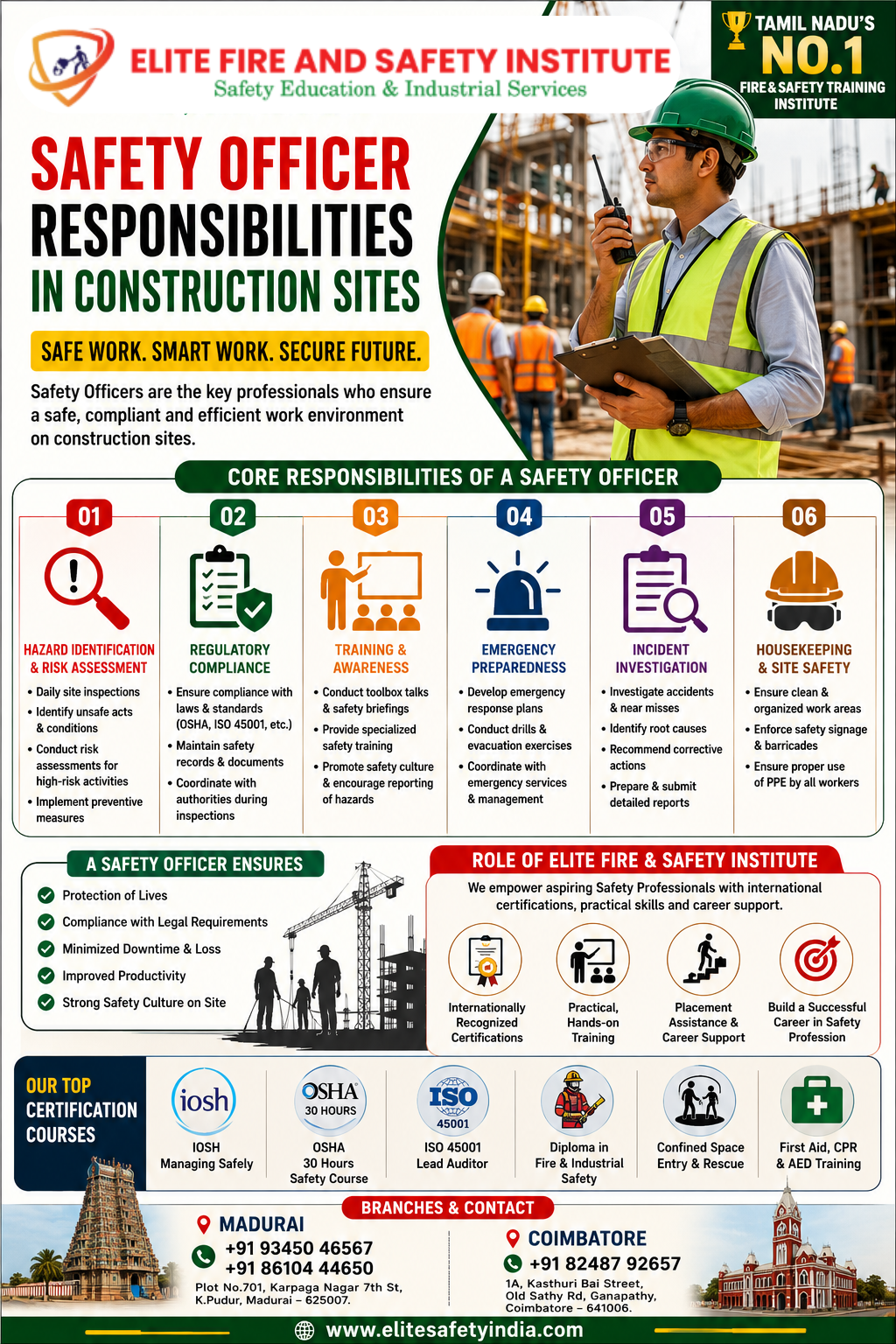
Safety Officer Responsibilities in Construction Sites
Construction sites are inherently hazardous environments, with risks ranging from falls, electrocution, heavy machinery accidents, to fire hazards. A Safety Officer is the key professional responsible for ensuring that these risks are minimized and that workers operate in a safe, compliant, and efficient manner. Their responsibilities can be grouped into several core areas:
1. Hazard Identification and Risk Assessment
- Daily Inspections: Safety Officers conduct routine site inspections to identify unsafe conditions such as unstable scaffolding, improper electrical wiring, or unguarded machinery.
- Risk Assessment: Before any high-risk activity (e.g., crane operations, excavation, confined space entry), they perform detailed risk assessments to evaluate potential hazards.
- Preventive Measures: They apply the Hierarchy of Controls—eliminating hazards where possible, substituting safer methods, implementing engineering controls, enforcing administrative rules, and ensuring proper PPE usage.
2. Regulatory Compliance
- Legal Standards: Safety Officers ensure compliance with local labor laws, building codes, and international standards such as OSHA and ISO 45001.
- Documentation: They maintain records of safety audits, permits-to-work, accident reports, and inspection logs.
- Coordination with Authorities: During government inspections, Safety Officers act as the liaison, ensuring transparency and compliance.
3. Training and Awareness
- Toolbox Talks: Short, daily safety briefings are conducted to remind workers of site-specific hazards and safe practices.
- Specialized Training: Workers are trained in safe handling of equipment, working at heights, confined space entry, and emergency procedures.
- Safety Culture: Safety Officers encourage workers to report hazards and near misses, fostering a proactive safety culture.
4. Emergency Preparedness
- Emergency Plans: They design and implement emergency response plans tailored to the site’s risks.
- Drills: Regular fire drills, evacuation exercises, and first aid training sessions are organized.
- Coordination: In case of emergencies, Safety Officers coordinate with medical teams, fire services, and site management to ensure swift response.
5. Incident Investigation
- Accident Analysis: When incidents occur, Safety Officers investigate to identify root causes.
- Corrective Actions: They recommend measures to prevent recurrence, such as redesigning workflows or reinforcing training.
- Reporting: Detailed reports are prepared for management and regulatory bodies.
6. Housekeeping and Site Safety
- Clean Workspaces: They enforce proper waste disposal, clear walkways, and organized storage of materials.
- Safety Signage: Placement of warning signs, barricades, and hazard labels is monitored.
- PPE Enforcement: Safety Officers ensure strict compliance with PPE requirements—helmets, gloves, harnesses, boots, and reflective vests.
Role of Elite Fire and Safety Institute
While Safety Officers are indispensable on construction sites, their effectiveness depends on quality training and certification. This is where Elite Fire and Safety Institute, based in Tamil Nadu, plays a transformative role.
1. Professional Certifications
Elite Fire and Safety Institute offers globally recognized certifications that prepare professionals for diverse safety challenges:
- IOSH Managing Safely – Internationally respected safety management training.
- OSHA 30 Hours Safety Course – U.S. standard workplace safety certification.
- ISO 45001 Lead Auditor – Qualification for auditing occupational health and safety systems.
- Diploma in Fire & Industrial Safety – Specialized training for construction and industrial environments.
2. Practical Training
Unlike purely theoretical programs, Elite emphasizes hands-on training:
- Firefighting Drills: Using real equipment to simulate fire emergencies.
- Confined Space Rescue: Training in entry, monitoring, and rescue operations.
- Work-at-Height Safety: Demonstrations of harness use, scaffolding safety, and fall arrest systems.
- First Aid & CPR: Life-saving skills including AED operation.
- Mock Toolbox Talks: Practice sessions to prepare trainees for real-world worker engagement.
3. Career Development
Elite Fire and Safety Institute supports students beyond training:
- Resume Building: Guidance on presenting safety qualifications effectively.
- Interview Preparation: Coaching for job interviews in India and abroad.
- Placement Assistance: Strong industry connections help graduates secure positions in construction, oil & gas, and manufacturing sectors.
- Career Progression: Support for advancing from Safety Officer to Safety Manager or HSE Director.
4. Industry Recognition
- Recognized as Tamil Nadu’s No.1 Fire & Safety Training Institute.
- Alumni are employed in leading construction and industrial companies worldwide.
- Trusted by students across Madurai, Coimbatore, Chennai, and other regions.
Conclusion
Safety Officers are the guardians of construction sites, ensuring that workers return home safely each day. Their responsibilities span hazard identification, compliance, training, emergency preparedness, and incident investigation. However, their effectiveness depends on robust training and certification.
This is where Elite Fire and Safety Institute makes a profound impact—equipping professionals with international certifications, practical skills, and career support. By bridging the gap between theory and practice, Elite ensures that Safety Officers are not only compliant with regulations but also capable of leading safety culture on construction sites.
Together, Safety Officers and Elite Fire and Safety Institute form a powerful alliance in safeguarding lives, protecting property, and strengthening the foundation of modern infrastructure.
Branches & Contact:
Madurai:
+91 93450 46567 +91 8610444650
Plot No.701, Karpaga Nagar 7th St, K.Pudur, Madurai – 625007.
Coimbatore:
+91 8248792657
1A, Kasthuri Bai Street, Old Sathy Rd, Ganapathy, Coimbatore – 641006.