

Work at Height Safety
Introduction
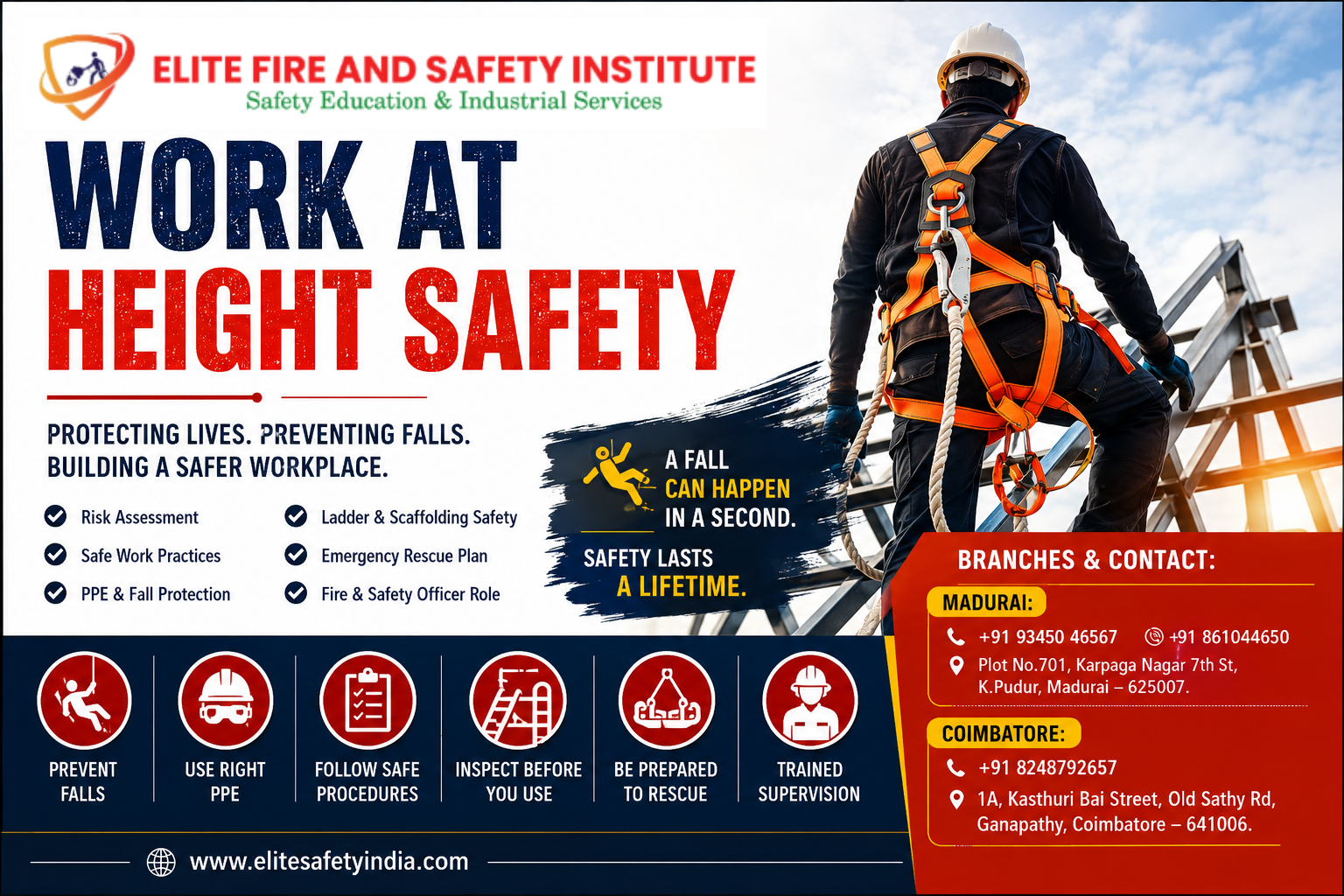
Work at Height (WAH) refers to any work performed in a location where a person could fall from one level to another and sustain an injury. It includes activities carried out on ladders, scaffolding, roofs, elevated platforms, towers, cranes, and any area with open edges or floor openings. Falls from height are among the leading causes of serious injuries and fatalities in industries such as construction, oil and gas, manufacturing, power plants, warehousing, and maintenance. Therefore, implementing proper work at height safety procedures is essential to protect workers, equipment, and property.
An Elite Fire & Safety Officer plays a critical role in ensuring that all work at height activities are performed safely by enforcing safety standards, conducting inspections, providing training, and responding to emergencies.
Importance of Work at Height Safety
Work at height safety aims to eliminate or minimize the risks associated with working above ground level. A single fall can result in severe injuries, permanent disability, or death. Proper planning, hazard identification, risk assessment, and the use of suitable protective equipment significantly reduce these risks.
Effective work at height safety also improves productivity, reduces accident-related costs, enhances employee confidence, and ensures compliance with occupational health and safety regulations.
Common Hazards in Work at Height
Several hazards are associated with working at height, including:
- Falls from ladders, scaffolding, roofs, or elevated platforms.
- Slips caused by wet, oily, or uneven surfaces.
- Unprotected edges and floor openings.
- Falling tools or construction materials striking workers below.
- Scaffolding collapse due to improper erection or overloading.
- Contact with overhead electrical power lines.
- Strong winds, rain, or poor weather conditions affecting worker stability.
- Improper use or failure of personal protective equipment (PPE).
Recognizing these hazards before beginning work is the first step toward preventing accidents.
Risk Assessment
Before any work at height begins, a detailed risk assessment should be carried out. The purpose is to identify hazards, evaluate risks, and implement suitable control measures.
The risk assessment process includes:
- Identifying hazards in the work area.
- Determining who may be affected.
- Evaluating the likelihood and severity of potential incidents.
- Implementing preventive and protective measures.
- Reviewing the assessment whenever work conditions change.
No work should begin until all identified risks have been controlled.
Safe Work Practices
Safe work at height requires careful planning and strict adherence to safety procedures. Workers should receive proper training and be competent to perform the assigned tasks.
Important safe work practices include:
- Obtain a valid Work at Height Permit before starting work.
- Inspect ladders, scaffolding, and work platforms before use.
- Use approved access equipment only.
- Maintain good housekeeping to prevent slips and trips.
- Secure tools using tool lanyards to prevent falling objects.
- Never overload platforms or scaffolding.
- Stop work immediately during severe weather conditions.
- Ensure proper communication between workers and supervisors.
- Always maintain three points of contact while climbing ladders.
Following these practices significantly reduces the likelihood of workplace accidents.
Personal Protective Equipment (PPE)
Personal Protective Equipment provides the final level of protection against falls and other hazards. Workers involved in work at height should wear:
- Safety helmet with chin strap.
- Full-body safety harness.
- Shock-absorbing lanyard.
- Double lanyard for continuous attachment.
- Safety shoes with anti-slip soles.
- Protective gloves.
- High-visibility safety vest.
- Eye protection when required.
All PPE should be inspected before use. Damaged or defective equipment must be replaced immediately.
Scaffolding and Ladder Safety
Scaffolding should only be erected by trained and authorized personnel. It must be built on stable ground and equipped with guardrails, midrails, toe boards, and safe access points. Regular inspections should be carried out to ensure structural stability.
Ladder safety is equally important. Workers should:
- Inspect ladders before use.
- Place ladders on firm and level surfaces.
- Maintain the recommended climbing angle.
- Never stand on the top rung.
- Face the ladder while climbing.
- Avoid carrying heavy loads while ascending or descending.
Using ladders correctly greatly reduces fall-related incidents.
Fall Protection Systems
Whenever there is a risk of falling, appropriate fall protection systems should be used. These include:
- Full-body safety harnesses.
- Energy-absorbing lanyards.
- Self-retracting lifelines (SRLs).
- Horizontal and vertical lifelines.
- Certified anchor points.
- Safety nets where applicable.
- Guardrails and edge protection systems.
These systems prevent workers from falling or minimize injuries if a fall occurs.
Emergency Rescue Plan
Every work at height activity should have a documented rescue plan. Depending only on emergency medical services is not sufficient because suspended workers require immediate rescue to prevent suspension trauma.
A rescue plan should include:
- Emergency contact procedures.
- Trained rescue personnel.
- Rescue equipment available at the worksite.
- First aid arrangements.
- Safe evacuation procedures.
- Communication methods during emergencies.
Regular emergency drills ensure that workers know how to respond quickly and effectively.
Role of an Elite Fire & Safety Officer
An Elite Fire & Safety Officer is responsible for protecting employees, property, equipment, and the environment through effective implementation of occupational health, safety, and fire prevention measures.
The officer conducts routine workplace inspections, identifies hazards, recommends corrective actions, and ensures compliance with company safety policies and legal requirements. They monitor work at height activities, verify permits, inspect PPE, and ensure workers follow approved procedures.
Another important responsibility is fire prevention. The officer inspects fire extinguishers, fire alarm systems, hydrants, sprinkler systems, emergency lighting, and exit routes to ensure they remain operational and accessible.
The Fire & Safety Officer also conducts risk assessments for hazardous activities, including hot work, confined space entry, excavation, electrical isolation, lifting operations, and work at height. Based on these assessments, appropriate control measures are implemented to minimize risks.
Training is another major responsibility. The officer organizes induction training for new employees, conducts toolbox talks, provides PPE awareness sessions, and educates workers on emergency procedures, fire safety, and accident prevention.
During emergencies such as fires, chemical spills, or rescue operations, the Fire & Safety Officer coordinates evacuation, communicates with emergency responders, assists rescue teams, and ensures that all personnel are accounted for.
Following accidents or near misses, the officer investigates the incident to determine root causes and recommends corrective and preventive actions. Detailed reports are prepared to prevent similar incidents in the future.
The officer also manages safety documentation, including permit-to-work records, inspection reports, incident reports, training records, fire equipment maintenance logs, emergency drill reports, and risk assessments. Accurate documentation supports legal compliance and continuous improvement.
Conclusion
Work at height remains one of the highest-risk activities in many industries. Proper planning, hazard identification, risk assessment, use of suitable personal protective equipment, fall protection systems, and effective supervision are essential to prevent accidents. Safety is not solely the responsibility of one individual; it requires the commitment of employers, supervisors, and workers alike.
An Elite Fire & Safety Officer plays a vital role in maintaining a safe working environment by enforcing safety procedures, conducting inspections, providing training, preventing fires, investigating incidents, and coordinating emergency response activities. Through proactive safety management and continuous improvement, organizations can reduce workplace injuries, protect valuable assets, and promote a strong safety culture where every employee returns home safely at the end of the working day.
Branches & Contact:
Madurai:
+91 93450 46567 +91 8610444650
Plot No.701, Karpaga Nagar 7th St, K.Pudur, Madurai – 625007.
Coimbatore:
+91 8248792657
1A, Kasthuri Bai Street, Old Sathy Rd, Ganapathy, Coimbatore – 641006.